A bottle you cork, two goblets you keep
There is a small ceremony in opening a clay bottle. You take the cork between two fingers, twist, and it releases with a soft sound that glass never makes. Then the pour — slow, because the neck is narrow by design, a steady thread of wine falling into a goblet that already feels cool in your palm. The whole thing takes four seconds longer than uncapping a bottle from the shop. Those four seconds are the point.
This set is three pieces: one lidded clay bottle with a cork stopper holding a full litre, and two footed goblets sized for sipping rather than gulping. All three were thrown by hand on a potter's wheel in our workshop in Ukraine.
What Makes It Special
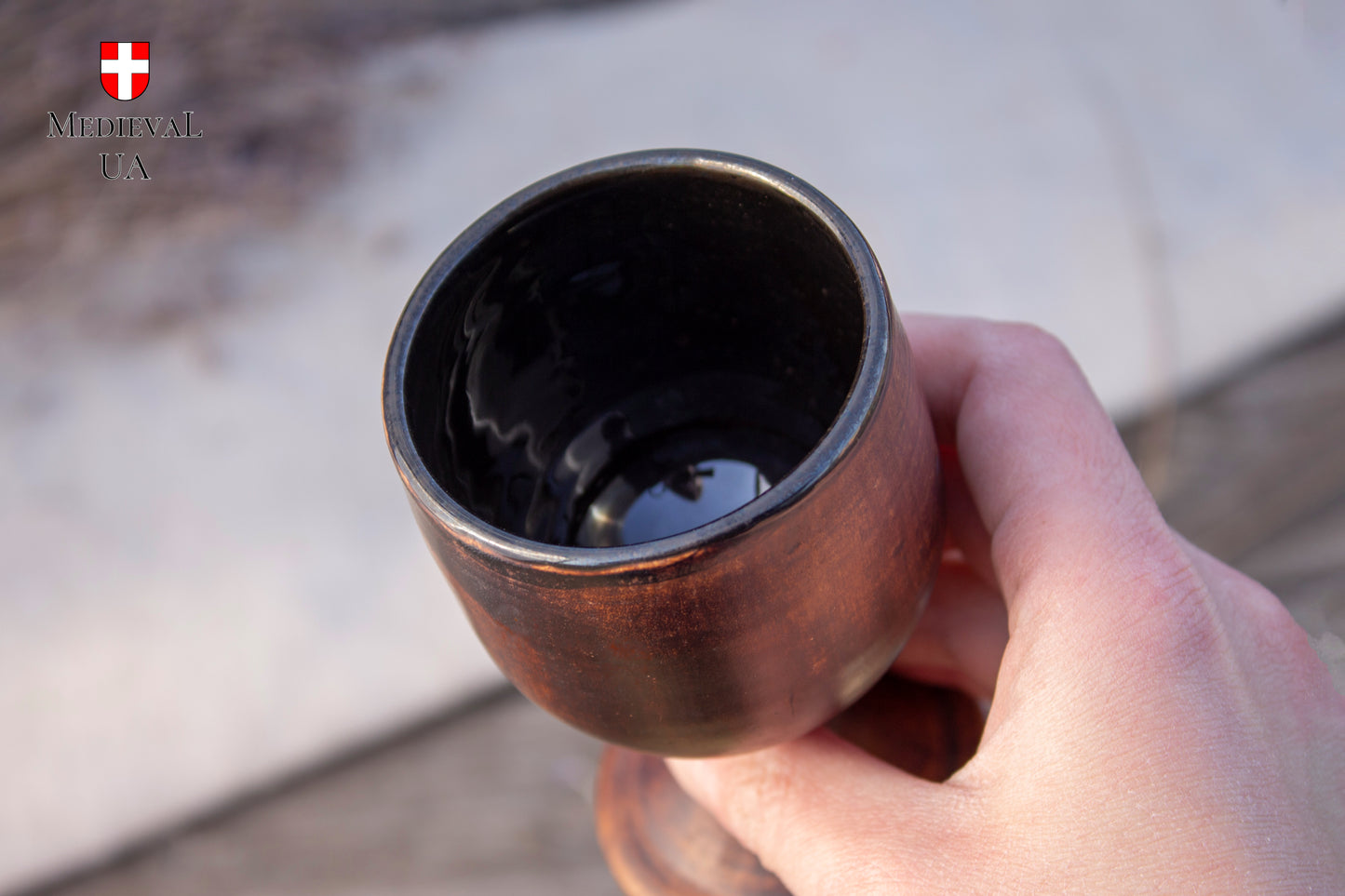
Look closely at the photographs and you will notice something unusual: the outside and the inside of these vessels are two entirely different materials.
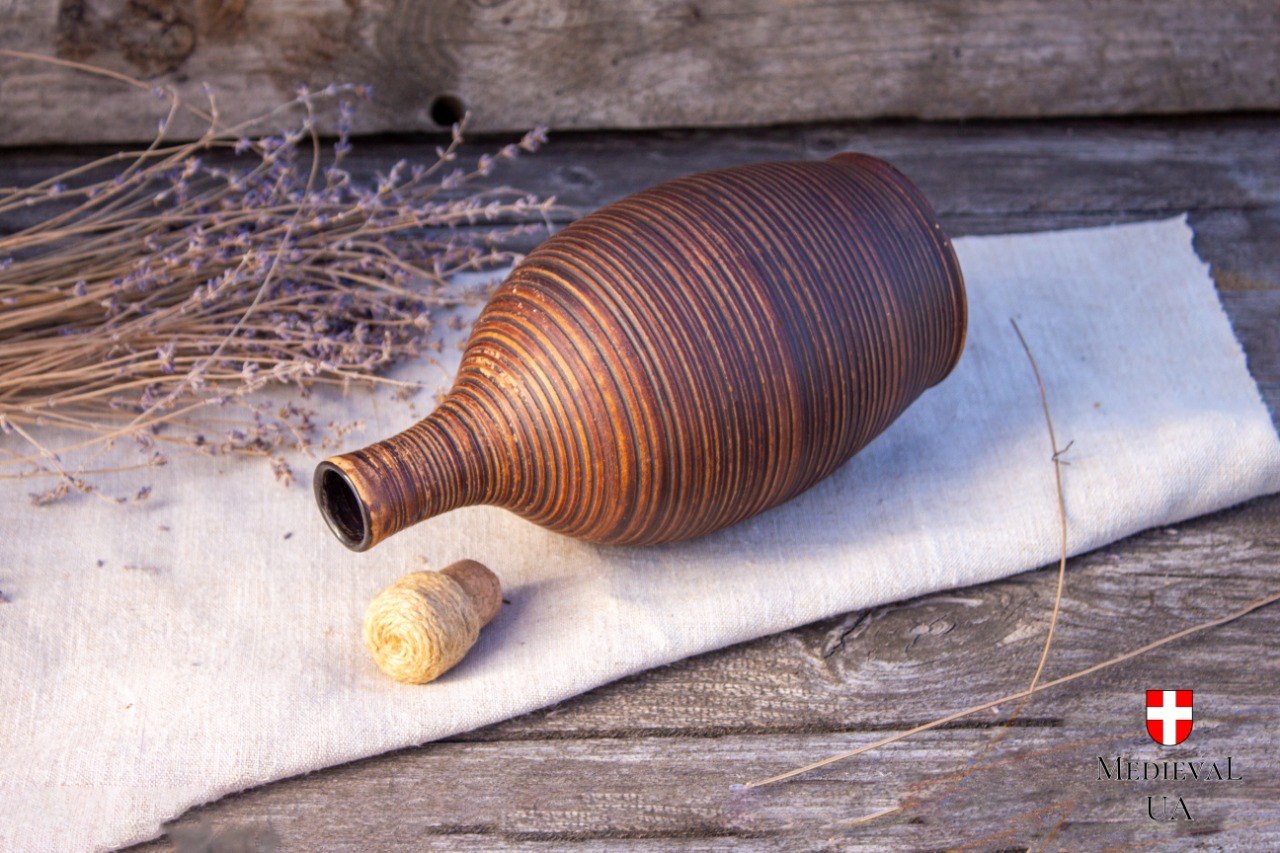
Outside — bare clay, warm copper-brown, ribbed with fine horizontal throw lines that catch the light. Matte, slightly textured, dry to the touch. This surface comes from milk firing: while the fired piece is still hot, milk is applied to the clay and burns into it, caramelising into that deep amber-brown tone. No pigment, no paint. The colour is a chemical event, not a coating.
Inside — a deep black glaze, glossy as a river stone, sealing the interior completely.
That combination is deliberate. The raw exterior gives you the honest weight and grip of ancient pottery; the glazed interior gives you a non-porous, food-safe, easy-to-rinse surface that will not absorb the colour or scent of red wine over time. You get the object of a thousand years ago and the practicality of today, in one piece.
Getting there takes three separate firings:
Bisque firing — the raw clay is hardened into durable ceramic
Milk firing — the traditional treatment that produces the exterior colour and sheen
Glaze firing — the black interior glaze is fused to the walls
Each firing is a chance for a piece to fail, which is why the shade of brown varies subtly from one item to the next. Your set will not look identical to the photographs, and no two sets leaving the workshop look identical to each other.
The Story Behind the Shape
The bottle's profile — a full oval body narrowing to a slim, upright neck — is one of the oldest containers in European pottery. It exists because it works. The wide belly holds volume without height; the narrow neck slows evaporation, accepts a cork, and gives you control over the pour. The dense ring of throw lines running from base to lip is the potter's fingertip recorded in clay as the wheel turned, left visible instead of smoothed away.
The goblets are built the way medieval drinking vessels were built: a rounded bowl on a short stem and a wide, weighted foot. That foot matters more than it looks. It lowers the centre of gravity so a goblet does not tip on an uneven table, and it keeps the warmth of your hand away from what's in the bowl. At 120 ml, the pour is a measured one — the size that suits mead, port, fortified wine and strong ale rather than a casual half-pint.
Our workshop, Medieval UA, reconstructs historical and folk vessel forms from the region, working in small batches by hand from start to finish.
How People Use It
Wine, mead, port and cider. The glazed interior is neutral and non-absorbent, so nothing carries over between pours.
A decanter that lives on the table. Transfer a bottle of red into the clay, cork it, and leave it out — it looks far better than the original bottle and keeps the wine out of the light.
Olive oil, vinegar, syrups and infusions. The cork seal and opaque body make the bottle genuinely useful in a kitchen, not just decorative.
Re-enactment, LARP and ren faire. Period-plausible silhouettes with no modern gloss on the outside, and the durability to survive being packed, carried and used at an event.
Anniversaries and table settings for two. Two goblets, one bottle — the set is built for a table of two people without looking like a half-empty six-piece.
Interiors and styling. Farmhouse, rustic, dark academia, cottagecore, wabi-sabi. Corked and empty on a shelf the bottle holds its own; it also takes a few stems of dried lavender or wheat beautifully.
Photography and props, where matte clay behaves far better under natural light than reflective glass or glaze.
Materials
Body: Natural clay, thrown by hand on the wheel
Exterior: Unglazed, coloured by traditional milk firing
Interior: Black food-safe glaze, fully sealed
Firings: Three — bisque, milk, glaze
Stopper: Natural cork, included
Decoration: None applied; all colour comes from firing
Why the split surface matters in practice: an entirely unglazed vessel breathes and keeps drinks cool but stains and needs careful drying. A fully glazed one is easy to clean but loses the raw tactile quality. Glazing only the interior gives you the useful half of each — the outside stays honest clay, the inside rinses clean with warm water.
Dimensions
Clay bottle with cork stopper (×1)
Height — 27 cm / 10.6 in
Neck diameter — 2.5 cm / 1.0 in
Widest diameter — 11.5 cm / 4.5 in
Base diameter — 9 cm / 3.5 in
Weight — 762 g / 1.68 lb / 26.9 oz
Working volume — 1 L / 33.8 US fl oz
Capacity to the brim — 1.1 L / 37.2 US fl oz
Goblet (×2 included)
Height — 10.5 cm / 4.1 in
Rim diameter — 5.5 cm / 2.2 in
Widest diameter — 6 cm / 2.4 in
Foot diameter — 6 cm / 2.4 in
Weight — 150 g / 0.33 lb / 5.3 oz each
Working volume — 120 ml / 4.1 US fl oz
Capacity to the brim — 150 ml / 5.1 US fl oz
Total set weight is approximately 1.06 kg / 2.34 lb. Because every piece is thrown individually, small differences of a few millimetres between the two goblets are normal.
Care Instructions
- Hand wash only, shortly after use — rinse the bottle with warm water while the interior is still wet
- A soft cloth or sponge is enough; baking soda removes any residue from the unglazed exterior
- Not dishwasher safe. Not for microwave, oven or open flame
- Do not leave the pieces soaking — the outer clay body is porous
- Dry the bottle standing upright and uncorked so air can circulate inside
- Store the cork separately if the bottle will sit unused for a long period
- Keep out of direct sunlight
- Refrigeration is fine; sudden temperature shifts (freezer to hot water) are not
A Gift That Lands
This one is easy to give and hard to forget. It suits an anniversary or wedding particularly well, because a set of exactly two goblets carries an obvious meaning that a set of six does not. It's a natural choice for him or for a couple, for a re-enactor, LARPer or history enthusiast, for anyone who brews mead or takes wine seriously, for a housewarming, or for the friend whose home is full of objects with a story rather than a barcode.
Gift packaging is available for a small additional fee — leave a note at checkout or send us a message.
Shipping
Sent from Ukraine, standard delivery 2–3 weeks; expedited available on request. Every set is padded and reinforced for international transit — protective packaging is always included in the shipping price. US orders ship with duties prepaid; buyers elsewhere are responsible for local import charges.
Pour something worth pouring, hand the second goblet to the person across the table, and let the bottle sit corked between you until it's needed again. That's what it was made for.