

MedievalUA
Handmade Clay Pitcher & 6 Cups – Medieval Feast Set
Handmade Clay Pitcher & 6 Cups – Medieval Feast Set
Couldn't load pickup availability
Clay, milk and fire — the way a table was set a thousand years ago
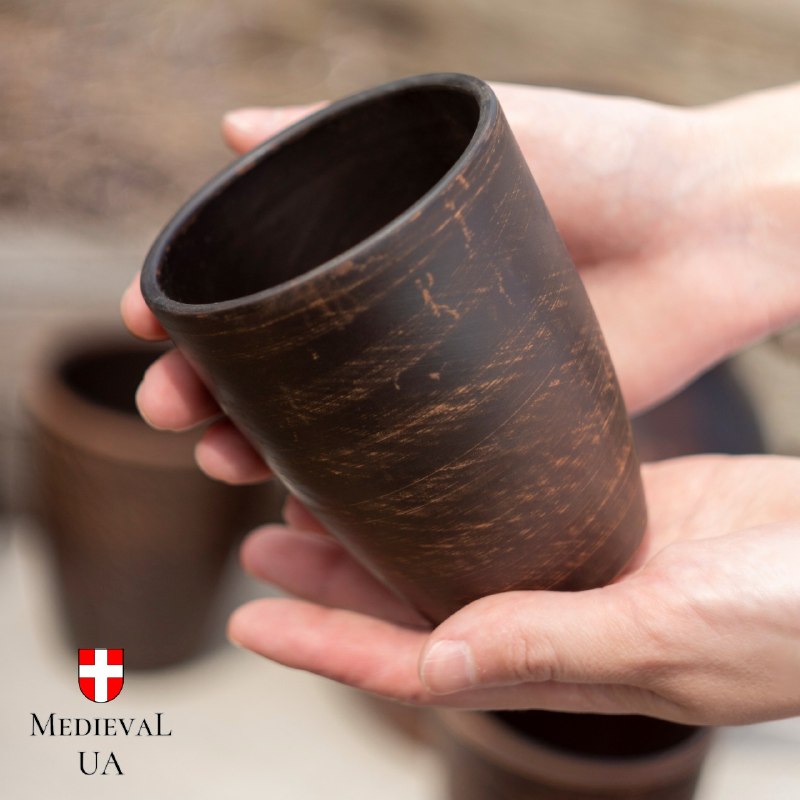
Pick up one of these cups and the first thing you notice is the weight. Not heavy, but present — the kind of density that tells you a pair of hands pressed this shape into being on a spinning wheel, and that the clay came out of the ground rather than out of a mould. Run a thumb across the wall and you feel the faint spiral where the potter's fingers travelled upward. Every cup carries a slightly different rhythm of those marks. That is not a flaw in the finish. That is the finish.
This is a full serving set: one lidded pitcher and six matching cups, made as a single family so that the colour, the throw lines and the smoky depth belong together on one table.
What Makes It Special
Nothing here is coated. There is no glaze on this pottery — not on the pitcher, not inside the cups. The deep chestnut-and-black surface, the coppery streaks, the soft sheen you can see in the photographs: all of it is the result of firing, not painting.
The method is called milk firing, and it is genuinely old. Once the vessel has been fired and is still hot, it is bathed in milk. The milk proteins and sugars caramelise straight into the porous clay body, darkening it, sealing the surface and leaving that warm, weathered patina. Villages across Eastern Europe used this technique for centuries because it made everyday earthenware watertight and food safe long before industrial glazes existed. It is slower and less forgiving than glazing, and it is why no two pieces come out identical.
Each item is:
- Thrown by hand on a potter's wheel from natural red clay
- Kiln fired, then milk fired in the traditional manner
- Completely unglazed — no synthetic coatings, no painted decoration
- Food safe and watertight
- One of a kind in its exact shade and surface pattern
The Story Behind the Shape
The pitcher's silhouette is not a modern invention. That high shoulder, the narrow waisted neck, the pulled lip and the strap handle attached low on the body are the proportions medieval potters arrived at through pure practicality: a wide belly holds volume, a narrow neck slows the pour so nothing splashes, and a low handle balances the weight when the vessel is full. The fitted lid — turned separately, with a small pinch finial — keeps dust out and warmth in between rounds.
The cups follow the same logic. No handle, straight tapered walls, a base narrow enough to sit close on a crowded board. They stack neatly on a shelf, and they are shaped to be held in a full palm rather than pinched between fingers. At 300 ml, one pour is a proper drink, not a polite sip.
Our workshop, Medieval UA, works in Ukraine, reproducing the vessel forms found in the region's archaeology and folk pottery. Everything is made in small batches, by hand, start to finish.
How People Use It
A table for six. The pitcher's 1.65 L fills all six cups with plenty left over, so the host stays seated instead of shuttling to the kitchen.
Cold drinks, all summer. Unglazed clay holds cold remarkably well. Water, kvass, cider, lemonade and iced tea stay cool far longer than they would in glass.
Wine, mead, ale and cider. The neutral, uncoated body adds nothing to the taste.
Milk, buttermilk, juice and morning coffee, served the old way.
Re-enactment, LARP and living history. Historically plausible forms with no modern shine — the set photographs beautifully at events and around a fire.
Interiors. Farmhouse, rustic, cottagecore, wabi-sabi, dark academia, slow living. Left out on an open shelf or a sideboard the pitcher works as a standalone object, and it makes an excellent vase for dried lavender, wheat or eucalyptus when it isn't pouring.
Food photography and styling, where matte clay reads far better under natural light than reflective glazed ware.
Firing: Kiln fired, then traditional milk fired
Surface: Unglazed, sealed by the milk firing itself
Finish: Matte, smooth to the touch, food safe
Decoration: None applied — all colour comes from the fire
Why it matters: an unglazed body breathes. It keeps drinks cold, it never crazes or chips its coating the way glaze does, and there is no glaze chemistry between your drink and the clay. The trade-off is that the material asks for hand washing — see care below.
Dimensions
Pitcher with lid
- Height — 22 cm / 8.7 in
- Neck diameter — 10.5 cm / 4.1 in
- Widest diameter — 13 cm / 5.1 in
- Base diameter — 9 cm / 3.5 in
- Weight — 940 g / 2.07 lb / 33.2 oz
- Working volume — 1.65 L / 55.8 US fl oz
- Capacity to the brim — 1.7 L / 57.5 US fl oz
Each cup (six included)
- Height — 11 cm / 4.3 in
- Rim diameter — 7.5 cm / 3.0 in
- Widest diameter — 8.5 cm / 3.3 in
- Base diameter — 5.5 cm / 2.2 in
- Weight — 218 g / 0.48 lb / 7.7 oz
- Working volume — 300 ml / 10.1 US fl oz
- Capacity to the brim — 350 ml / 11.8 US fl oz
Total set weight is approximately 2.25 kg / 4.9 lb. As each piece is thrown by hand, small variations of a few millimetres are normal and expected.
Care Instructions
- Hand wash only, soon after use — do not leave liquid standing in the vessel overnight
- Warm water with a soft cloth or sponge; baking soda lifts any stubborn residue
- Not dishwasher safe. Not for microwave, oven or open flame
- Avoid long soaking — porous clay absorbs water
- Dry fully, upright and uncovered, before storing
- Store away from direct sunlight and away from strong-smelling cupboards
- Expect the colour to deepen slightly over the first year of use. That darkening is the piece settling in, and it is considered a good sign
A Gift That Lands
Give this to the friend who hosts — the one whose kitchen table somehow always ends up with eight people around it. It suits a housewarming better than almost anything, because it arrives ready to be used the same evening. It's a strong choice for a wedding or anniversary, for a re-enactor, LARPer or history enthusiast, for a mead or craft-beer drinker, for parents and grandparents who appreciate things made properly, and for anyone furnishing a first home with pieces meant to last.
Gift packaging is available for a small additional fee — leave a note at checkout or message us and we'll prepare it.
Shipping
Sent from Ukraine, standard delivery 2–3 weeks; expedited available on request. Every set is padded and reinforced for international transit — protective packaging is always included in the shipping price. US orders ship with duties prepaid; buyers elsewhere are responsible for local import charges.
Some objects are bought. Others are put to work the day they arrive and are still on the table twenty years later, darker and better for it. Fill the pitcher, pass it round, and let it start earning its place in your home.